Product Description
Training platform will have following technicalfeatures
a On board display 7 capacitivetouchscreen
b Connectivity USB Ethernet HDMI
c Square Wave Generator up to 40KHz
d Low Pass Filter up to 30KHz
e High Pass Filter After 40KHz
f Inverting Amplifier Variable Gain110
g NonInverting Amplifier VariableGain 210
h Differential Amplifier Variable Gain110
i Instrumentation Amplifier VariableGain 1020
j Frequency to Voltage Input 110KHz
k Converter range Output 110Volt
l Voltage to Frequency Input 110Volt
m Converter range Output 110KHz
n Current to Voltage Input 420mA
o Converter range Output 05Volt
p Voltage to Current Input 05Volt
q Converter range Output 420mA
r AnalogDigital Converter 4 Channel05V
s DigitalAnalog Converter 1 Channel033V
t Input Output Ports 4IP 40P
u Operating Voltage Range 0 33V
v Ready assignment and exercise manuals
w Robust construction
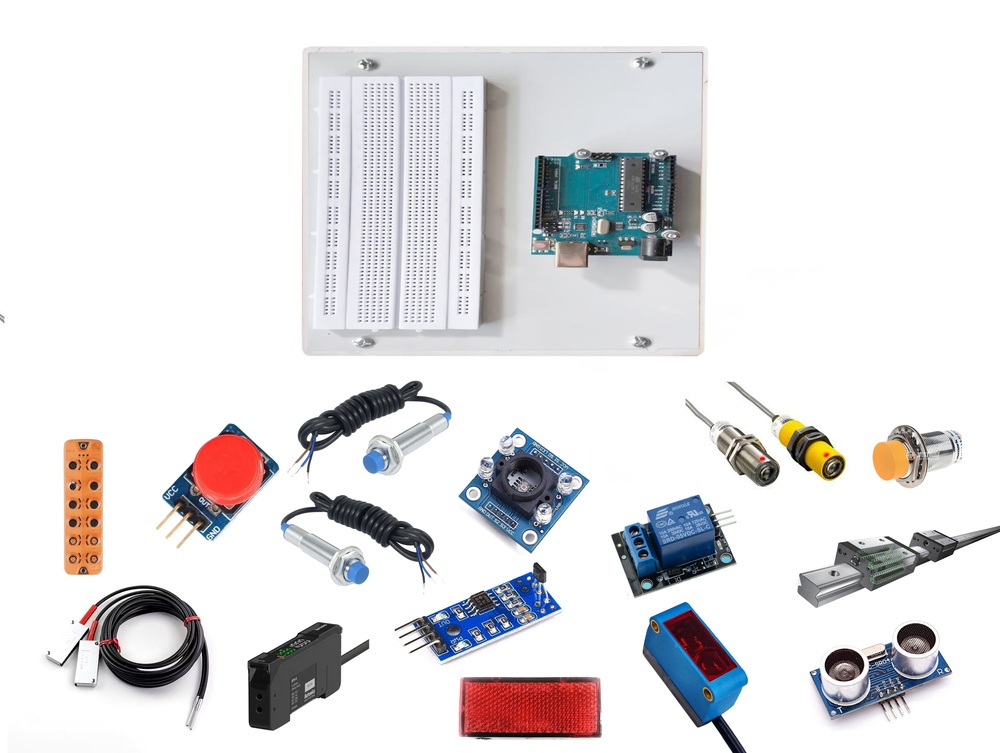
This training system will have thefollowing sensors of the given specifications as per the below given table
Temperature Sensors
1 LM35 10mV C
2 Platinum RTD 100W at 0C Tempcoefficient 0385 W C
3 K Type Thermocouple 0C to 80C
4 J Type Thermocouple 0C to 80C
5 AD590 55C to 150C
6 NTC Thermistor 47K
Optical Sensors
1 L14G1 Photo Transistor 500nm 1100nm
2 Photovoltaic Cell 500mV 580mV
3 Phot Diode 500nm 1100nm
IR Sensors
1 TSOP 1738
2 IR LED
Pressure Sensor
1 Pressure Transducer 0 to 60 psidifferential input
2 Foot Pump 0 to 60 psi
3 Supply Voltage 5V DC
LVDT Coil
1 Measurement Range 20 mm 10 mm
3 Excitation Voltage 4Vppapproximately
4 Micrometer Scale 25 mm
5 Micrometer Least count 001 mm
2 Excitation Frequency 4 KHzapproximately
Load Cell
1 Rated Load 6 Kg
2 Supply Voltage 12V DC
3 Resistance 350 3
Strain Gauge
1 Strain Gauge 350 4 Nos
2 Gauge Factor 21
3 Maximum Bearable Weight 500 Gms
4 Cantilever Material StainlessSteelMS
5 Bridge Configuration Full Bridge
Gas Sensor
1 Supply Voltage 5V DC
2 Warm up Time 10 Min
3 Calibrated Gas 1000 ppm isobutane
Alcohol Sensor
1 Supply Voltage 5V DC
2 Output Voltage 0 to 5V DC
3 Warm up Time 10 Mins
Optocoupler Sensor
1 Input Voltage 5V
2 Output Voltage 5V approximately
Magnetic Reed Sensor
1 Maximum Voltage 5Vdc
2 Maximum Current 05A at up to 10W
3 Magnetic Reed Switch Type Normally
Level Sensor
1 Transducer Capacitive Type
2 Level Measurement Range 2 3 Liter
Accelerometer Sensor
1 Supply Voltage 33V DC
2 ADC channel X Y Z 3
3 Operating Current 1ma
4 Zero G output voltage X Y Z Idleoutput is VDD2 So 33V2165V
Temperature Humidity Sensor
1 Supply 5V DC
2 Operating Humidity 0 to 100 RH
3 Output Signal Analog Voltage
4 Temperature Range 0 to 100 C
5 Output Signal Analog Voltage
Air Quality Sensor
1 Supply 33V to 5V
2 Output Signal Analog Voltage
3 Detection Range 10 300 ppm NH3 10 1000 ppm Benzene 10 300ppm Alcohol
4 Heater Voltage 50V
PIR Sensor Atmospheric Pressure Sensor
1 Supply Voltage 5V DC
2 Detection Range 6 Meters
1 Supply Voltage 5V
2 Pressure Range
3 Min 15kPa
4 Max 115 kPa
Versatile Sensor Training with Modular InputsThe SL-2000 boasts eight independent sensor channels, enabling simultaneous interfacing and analysis of different sensor types. From temperature and pressure to humidity and proximity, it provides hands-on training opportunities for a wide range of engineering and research applications. Designed for flexibility, modules can be easily interchanged, supporting varied experimental setups.
Robust Construction for Reliable PerformanceBuilt with a high-grade aluminum frame, powder-coated metal panel, and insulated, corrosion-resistant materials, the SL-2000 is engineered to withstand rigorous academic and industrial environments. The free-standing base with adjustable legs ensures stability, while its digital and analog displays offer clear data visualization during experiments.
Enhanced Safety and Usability FeaturesSafety is integral to the Sensor Lab SL-2000, featuring in-built fuse protection and an emergency power cut-off switch. The platform's factory calibration ensures precise readings, while users also have the option to recalibrate for specific modules. The system is simple to install and operate, making it suitable for instructors, students, and industry professionals alike.
FAQ's of Sensor lab Sensor training platform:
Q: How do I connect the Sensor Lab SL-2000 to an external PC?
A: You can connect the Sensor Lab SL-2000 to an external PC using the built-in USB or RS232 ports. These digital interface options enable seamless data transfer and enable software-based monitoring, analysis, and report generation from your computer.
Q: What types of sensor modules are included, and can I add more?
A: The SL-2000 comes with modules for temperature, pressure, proximity, level, flow, humidity, RTD, and thermocouple sensors. You can easily interchange these modules, and the platform supports up to eight simultaneously. Additional compatible modules can be integrated as needed for extended applications.
Q: When is user re-calibration necessary and how is it performed?
A: User re-calibration is recommended if you observe measurement drifts or after extended usage. To recalibrate, follow the included instructions, using reference standards suitable for each module. Factory calibration ensures accuracy from the outset, but periodic re-calibration may help maintain performance over time.
Q: Where is the Sensor Lab SL-2000 best installed for optimal performance?
A: For best results, install the SL-2000 indoors in a dry, dust-free environment within its operating temperature range of 0C to 100C. The sturdy, adjustable legs provide flexibility for various lab or classroom layouts, ensuring stable and reliable operation in educational or research settings.
Q: What benefits does the Sensor Lab SL-2000 provide to engineering colleges and vocational institutes?
A: The SL-2000 offers practical, real-time sensor data acquisition and analysis, supporting theoretical learning with hands-on training. Its modular design and real-world simulation capabilities help students and trainees build essential skills for careers in automation, instrumentation, and process engineering.
Q: How does the safety system function on this training platform?
A: The platform includes in-built fuse protection and an emergency power cut-off switch to safeguard users and equipment from electrical faults or emergencies. These safety mechanisms help ensure a secure training or research experience.
Q: What is the process for module exchange or configuring sensor inputs?
A: Modules can be swapped out easily thanks to the platform's quick-connect input channels. Follow the manual's step-by-step guide to safely remove and install modules. The digital interface detects new inputs, and real-time data is displayed instantly, enhancing flexibility during experiments.








 Send Inquiry
