Product Description
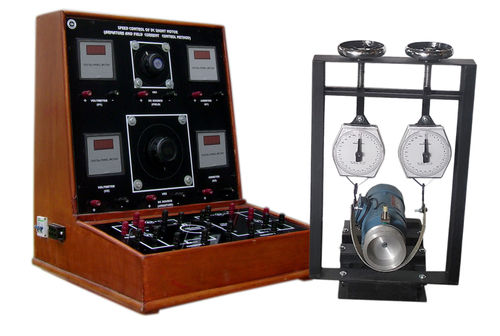
Speed Control of D.C. Shunt Motor
We M/s Mars Edpal Instruments Pvt. Ltd. dohereby solemnly affirm and declare that our firm has not been blacklisted forany other Central / State Govt. Dept./ University/ PSU etc.
Versatile Speed Control MethodsThis experimental kit offers variable speed control of a DC shunt motor using both field and armature rheostats, demonstrating traditional techniques used in laboratories and industry. Its analog meters enable precise monitoring of electrical parameters, allowing learners to observe the effects of different control methods in real time.
Safe and Reliable Laboratory UseBuilt with safety as a priority, the kit includes overload protection, fuses, earthing, and insulation Class B components. Its heavy-duty mounting base plate and vibration isolators enhance durability and user safety during operation, making it suitable for repeated academic and research activities.
Clear Design for Educational PurposesThe front panel features a well-labeled circuit layout, simplifying the experimental process. The powder-coated mild steel frame with an aluminum panel withstands rigorous handling. Banana plug terminations facilitate quick, secure wiring changes, streamlining setup for speed control demonstrations.
FAQ's of Speed Control of D.C. Shunt Motor:
Q: How does the speed control mechanism work in this DC shunt motor kit?
A: The kit enables speed variation of the DC shunt motor (up to 2000 RPM) through field and armature rheostats. Adjusting the field rheostat varies the field current, while the armature rheostat controls the armature voltage, allowing precise speed regulation as per experimental needs.
Q: What safety features are incorporated to protect users and the equipment?
A: This experimental kit includes overload protection, fuses, and earthing to safeguard users and components. All electrical parts are insulated to Class B standards, and a heavy-duty base plate with vibration isolators minimizes operational hazards.
Q: When is this apparatus typically used in laboratories?
A: The kit is best suited for speed control experiments, academic demonstrations, and R&D tasks where studying the characteristics of DC shunt motors is required. Its easy-to-use controls and comprehensive measurement capabilities make it ideal for both demonstration and analytical purposes.
Q: Where can I install or use this kit?
A: The apparatus is intended for indoor laboratory settings with ambient conditions below 45C and humidity below 85% RH. Its compact design makes it convenient for use in educational institutions and research labs across India and abroad.
Q: What is the process for measuring the motor speed, voltage, and current?
A: Motor speed is displayed using an analog tachometer (0-2000 RPM range), while voltage and current are monitored via analog voltmeter (0-300 V) and ammeter (0-10 A) meters on the front panel, allowing users to evaluate real-time performance as they adjust control parameters.
Q: How does using this kit benefit engineering students and researchers?
A: By providing hands-on experience with multiple speed control methods, analog measurement, and clear circuit diagrams, the kit helps users gain a thorough understanding of DC motor operation, reinforcing theoretical knowledge through practical application and analysis.








 Send Inquiry