Product Description
Training platform will have following technicalfeatures
a On board display 7 capacitivetouchscreen
b Connectivity USB Ethernet HDMI
c Square Wave Generator up to 40KHz
d Low Pass Filter up to 30KHz
e High Pass Filter After 40KHz
f Inverting Amplifier Variable Gain110
g NonInverting Amplifier VariableGain 210
h Differential Amplifier Variable Gain110
i Instrumentation Amplifier VariableGain 1020
j Frequency to Voltage Input 110KHz
k Converter range Output 110Volt
l Voltage to Frequency Input 110Volt
m Converter range Output 110KHz
n Current to Voltage Input 420mA
o Converter range Output 05Volt
p Voltage to Current Input 05Volt
q Converter range Output 420mA
r AnalogDigital Converter 4 Channel05V
s DigitalAnalog Converter 1 Channel033V
t Input Output Ports 4IP 40P
u Operating Voltage Range 0 33V
v Ready assignment and exercise manuals
w Robust construction
This training system will have thefollowing sensors of the given specifications as per the below given table
Temperature Sensors
1 LM35 10mV C
2 Platinum RTD 100W at 0C Tempcoefficient 0385 W C
3 K Type Thermocouple 0C to 80C
4 J Type Thermocouple 0C to 80C
5 AD590 55C to 150C
6 NTC Thermistor 47K
Optical Sensors
1 L14G1 Photo Transistor 500nm 1100nm
2 Photovoltaic Cell 500mV 580mV
3 Phot Diode 500nm 1100nm
IR Sensors
1 TSOP 1738
2 IR LED
Pressure Sensor
1 Pressure Transducer 0 to 60 psidifferential input
2 Foot Pump 0 to 60 psi
3 Supply Voltage 5V DC
LVDT Coil
1 Measurement Range 20 mm 10 mm
3 Excitation Voltage 4Vppapproximately
4 Micrometer Scale 25 mm
5 Micrometer Least count 001 mm
2 Excitation Frequency 4 KHzapproximately
Load Cell
1 Rated Load 6 Kg
2 Supply Voltage 12V DC
3 Resistance 350 3
Strain Gauge
1 Strain Gauge 350 4 Nos
2 Gauge Factor 21
3 Maximum Bearable Weight 500 Gms
4 Cantilever Material StainlessSteelMS
5 Bridge Configuration Full Bridge
Gas Sensor
1 Supply Voltage 5V DC
2 Warm up Time 10 Min
3 Calibrated Gas 1000 ppm isobutane
Alcohol Sensor
1 Supply Voltage 5V DC
2 Output Voltage 0 to 5V DC
3 Warm up Time 10 Mins
Optocoupler Sensor
1 Input Voltage 5V
2 Output Voltage 5V approximately
Magnetic Reed Sensor
1 Maximum Voltage 5Vdc
2 Maximum Current 05A at up to 10W
3 Magnetic Reed Switch Type Normally
Level Sensor
1 Transducer Capacitive Type
2 Level Measurement Range 2 3 Liter
Accelerometer Sensor
1 Supply Voltage 33V DC
2 ADC channel X Y Z 3
3 Operating Current 1ma
4 Zero G output voltage X Y Z Idleoutput is VDD2 So 33V2165V
Temperature Humidity Sensor
1 Supply 5V DC
2 Operating Humidity 0 to 100 RH
3 Output Signal Analog Voltage
4 Temperature Range 0 to 100 C
5 Output Signal Analog Voltage
Air Quality Sensor
1 Supply 33V to 5V
2 Output Signal Analog Voltage
3 Detection Range 10 300 ppm NH3 10 1000 ppm Benzene 10 300ppm Alcohol
4 Heater Voltage 50V
PIR Sensor Atmospheric Pressure Sensor
1 Supply Voltage 5V DC
2 Detection Range 6 Meters
1 Supply Voltage 5V
2 Pressure Range
3 Min 15kPa
4 Max 115 kPa
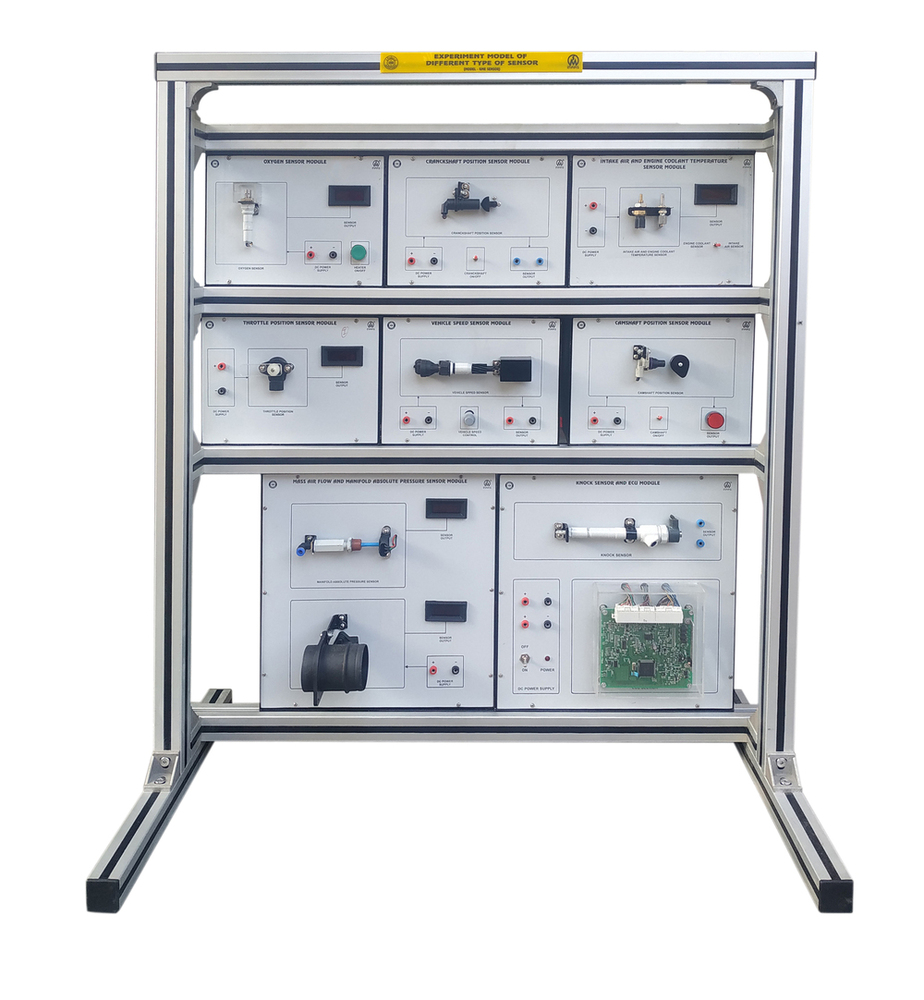
Versatile Sensor CompatibilityThe Sensor Lab Training Platform accommodates a broad range of sensors including temperature, pressure, humidity, flow, proximity, and optical types. Its modular design ensures adaptability, making it suitable for education, research, and demonstrations requiring various sensor technologies and experiment configurations.
Comprehensive Teaching and Calibration ToolsEquipped with experiment sheets, a user manual, and interconnecting cables, the system aids in the detailed study of sensor properties, calibration practices, and fault simulation. Manual and automatic calibration interfaces ensure students grasp key engineering concepts in a safe and controlled laboratory environment.
Safety and Robust ConstructionSafety remains paramount with features like overload protection, insulated wiring, and an emergency stop switch. Built on a durable, free-standing aluminum alloy frame and coated with industrial-grade powder or laminate, the platform is designed for longevity and high-frequency educational use.
User-Friendly Operation and ExpandabilityThe platform provides both analog and digital display panels for clear data visualization, while optional PC connectivity supports data logging and advanced analysis. Its multi-sensor input channels and support for additional modules ensure expandability to suit evolving academic demands.
FAQ's of Sensor lab Sensor training platform:
Q: How do I use the Sensor Lab Training Platform for multi-sensor experiments?
A: To conduct multi-sensor experiments, simply connect the desired sensor modules, utilizing the various digital and analog input/output connectors. The interchangeable design allows quick swapping or addition of sensors. Experiment sheets and the user manual guide users through setup and data acquisition.
Q: What types of sensors can be integrated with the platform?
A: The Sensor Lab supports a range of sensor types, including temperature, pressure, level, flow, humidity, proximity, optical, and several others. Additional sensor modules can also be added upon request, enhancing its adaptability for specific training needs.
Q: Where is the platform best operated, and what are its environmental requirements?
A: For optimal performance and safety, operate the platform in a lab environment with temperatures between 0C and 50C and humidity below 85% RH. The robust free-standing aluminum frame is designed specifically for stable operation in such educational or laboratory settings.
Q: What calibration processes are supported, and how do they benefit users?
A: The system supports both manual and automatic calibration features. These allow users to accurately calibrate sensors in real-time, reinforcing critical experiment concepts and ensuring reliable measurement results essential for both educational and research activities.
Q: When it comes to safety, what protections are in place for users?
A: The platform includes overload protection, insulated wiring, and an emergency stop switch to minimize risks during operation. These safety measures safeguard both users and equipment during experiments or demonstrations.
Q: How can data be outputted or analyzed from the platform?
A: Data can be monitored using the analog and digital display control panels. For further analysis or logging, the system offers data output for connecting to external PCs or data acquisition (DAQ) systems through an optional programming interface.
Q: What are the key benefits of using this sensor training platform for educational purposes?
A: The platform provides hands-on learning for sensor characteristics, calibration, and signal processing. Its practical demonstrations, expandability, and support for real-world fault simulation make it an invaluable tool for technical training and academic research.








 Send Inquiry
