Product Description
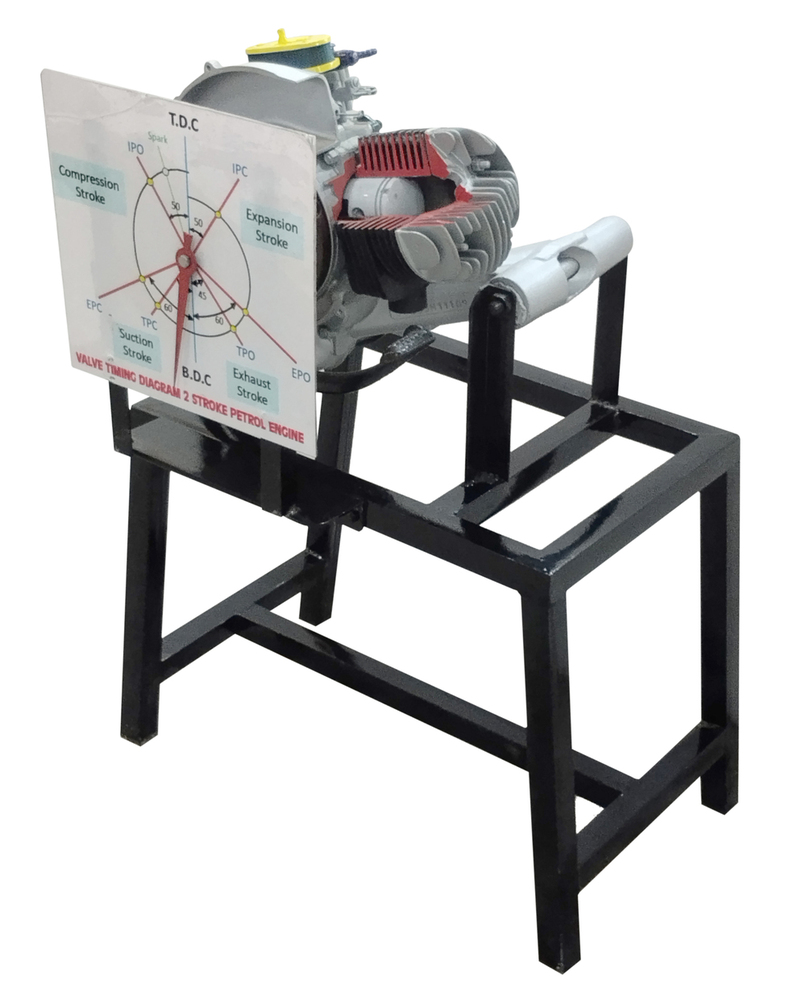
PETROL ENGINE MODEL FOR PORT TIMINGDIAGRAM
Demonstrationof valve and port timing in internal combustion engines, the apparatus shallconsist of one Spark Ignition (SI) engine model and one Compression Ignition(CI) engine model integrated into a combined demonstration unit. The systemshall feature a precision-engineered rotating disc mechanism, enabling accuratevisualization of the complete engine cycle. It shall provide clear indicationof inlet valve/port opening and closing, exhaust valve timing, ignition timingfor the petrol engine, and fuel injection timing for the diesel engine. A fixedpointer or indicator shall be provided for precise crank position trackingduring operation. The front side of the apparatus shall be fitted with atransparent acrylic/plexiglass cover to ensure safe operation while allowingunobstructed observation of the working mechanism. The rotating disc shallpermit smooth manual operation and shall also have provision for optionallow-speed geared motor drive. All discs and timing markings shall bemanufactured from corrosion-resistant materials with durable engraved orpermanently printed graduations. The complete unit shall be mounted on aheavy-duty powder-coated mild steel frame with a stable base support, making itsuitable for classroom demonstrations as well as laboratory practical trainingin engine timing and working principles.
Designed for Effective Engineering EducationThis hand-operated petrol engine model offers live demonstrations of port timing principles crucial in automotive studies. Visual aids such as color-coded ports and cut-away sections make complex concepts more accessible for students. Its durable steel construction ensures a long service life even with frequent use in classrooms and labs.
Comprehensive Visualization of Engine Port TimingThe model's precision-cut sections and integrated, analog timing chart facilitate an in-depth understanding of how intake, exhaust, and transfer ports open and close relative to crank angle. Included instructional materials and port labeling offer instructors flexibility as per syllabus needs.
FAQ's of PETROL ENGINE MODEL FOR PORT TIMING DIAGRAM:
Q: How does the Petrol Engine Model for Port Timing Diagram help in classroom learning?
A: This model enables students to visually observe and manually operate the mechanisms of a petrol engine's port timing, clarifying theoretical concepts with real-world motion and color-coded diagrams. It's specifically designed to support practical understanding in technical education.
Q: What maintenance does this engine model require during routine classroom usage?
A: Maintenance is minimal and consists mainly of periodic dusting and ensuring smooth operation of the hand crank. No lubrication or technical servicing is necessary, making it suitable for frequent handling in educational environments.
Q: When should this demonstration model be used in engineering curriculum?
A: It is best utilized during coursework sections covering internal combustion engines, engine mechanics, or port timing diagrams to supplement textbooks and lectures with hands-on demonstration and visible port movements.
Q: Where can this petrol engine port timing model be installed or set up for demonstrations?
A: Designed for educational settings, the model can be securely mounted on lab tables or demonstration benches in engineering colleges, polytechnic labs, and technical training centers. Its sturdy steel base provides stability during use.
Q: What is the process for operating the port timing demonstration model?
A: Operation is fully manual via a hand crank. As users turn the crank, they can observe internal motion through the cut-away section and simultaneously reference the analog port timing chart, which displays port cycles in relation to crank angle.
Q: What are the primary benefits of choosing this demonstration model?
A: This model enhances comprehension of engine port timing concepts through tangible, interactive demonstration. It is safe, low-maintenance, and customized for educational needs, making it reliable for repetitive classroom use and adaptable to varying curricula.









 Send Inquiry